You've been TQ'd. Click Here.
A Basic Bleed Control Kit: What to Include and Where to Buy Basic Bleed Control Kit

Disclosure: This article is not sponsored. We do not have any relationship with any of the vendors mentioned.
A basic bleed control kit gives YOU, an ordinary bystander, the tools to act before professional help arrives. Several respected trainers and organizations have offered their perspectives on what should be in a basic kit. This guide shows you what comes in popular pre-built kits, and recommends a minimal, effective setup for everyday carry or home readiness.
What a Basic Bleed Kit Looks Like
HoldMyTQ aims to equip more Americans with life-saving bleed control kits. But what does a basic kit look like? What does it include?
The entry-level kit from StoptheBleed.com includes components designed around the standard national curriculum:
- 1 – STOP THE BLEED® Instructional booklet
- 1 – C-A-T® tourniquet (Orange)
- 1 – NAR Wound Packing Gauze
- 1 – 4 in. Responder Flat Dressing
- 1 pair – Responder Nitrile Gloves – Large
- 1 – 7.25 in. Responder Trauma Shears
- 1 – Mini Permanent Marker, BLK
This kit gives you the tools needed to apply the the widely taught techniques:
- Applying a tourniquet
- Packing a wound
- Applying pressure to a wound
What the MyMedic “Bleed Stopper” Pack Includes
The Bleed Stopper Med Pack from MyMedic.com is a compact option suited for small bags, glove boxes, and range kits. Contents include:
- Mini EPB (emergency pressure bandage)
- QuikClot
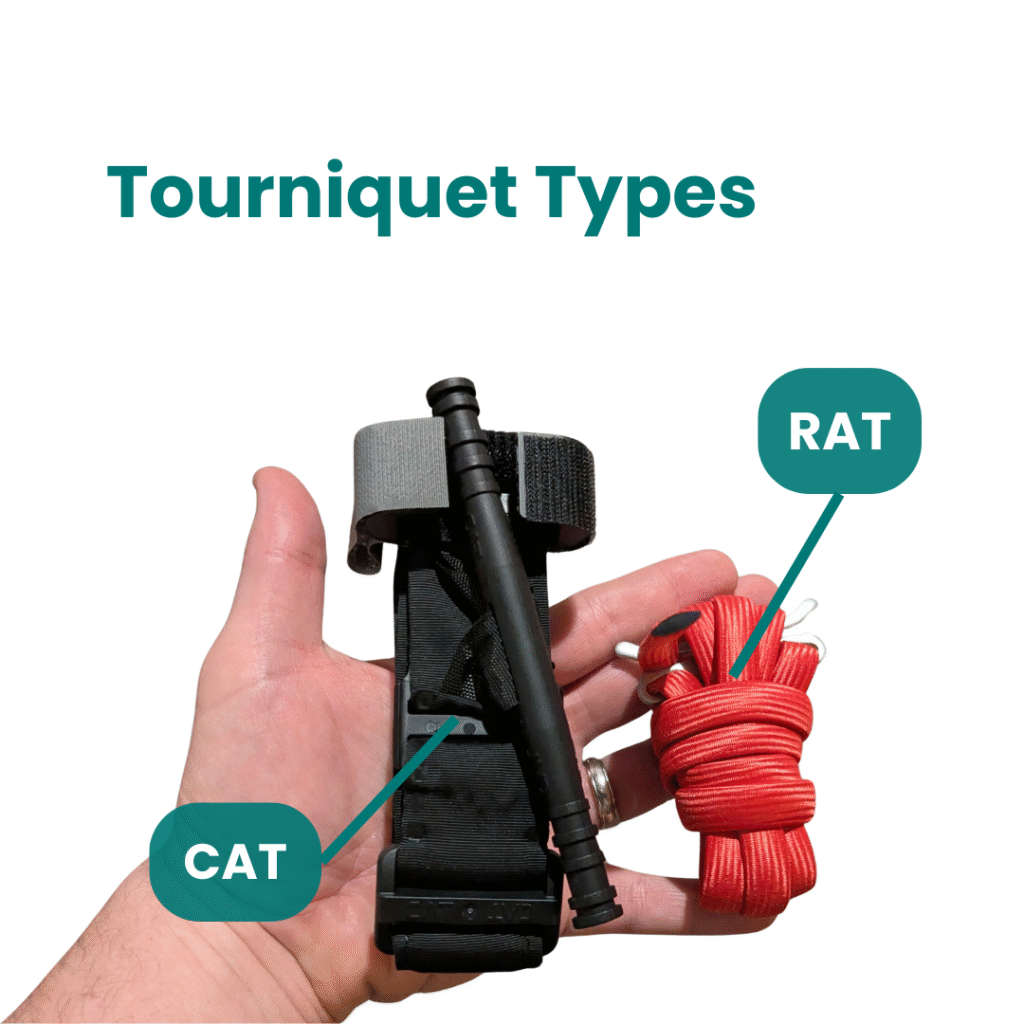
- RAT tourniquet (commonly referenced as suitable for small limbs, children, or animals)
- Gloves
- Super Hand Wipes (2)
- Compressed Gauze
- Marker
- EMT 5″ Shears
- Instructions for use
Its strength is portability. Instead of the widely used C-A-T type tourniquet, this kit offers the RATS for a slimmer design and for use on small children.
Insights From Experienced Operators
Other experts have shared their thoughts on minimalist kit builds. These are helpful for understanding priorities
Mark Geist’s Simple Kit (as described on the Shawn Ryan Show)
Mark Geist, retired U.S. Marine Corp., was a member of the Annex Security Team that fought the Battle of Benghazi. Geist mentions carrying a kit centered around,
- A tourniquet
- Shears
- (While he also mentions morphine, it is not appropriate or legal for civilian kits and is not recommended.)
With those three things you can do a whole lot of life-saving.
Mark Geist
Kyle Morgan’s Kit (as described on the Shawn Ryan Show)
Kyle Morgan is a retired U.S. Army and special forces operator. On a podcast interview, Morgan highlights a three-item kit. This setup reflects what many instructors consider the core of any layperson kit.
- A tourniquet
- A pressure bandage
- Packing gauze
Recommended Minimal Kit for a Layperson
After reviewing the Stop the Bleed curriculum, trusted pre-built kits, and operator input, a practical, minimal kit for most adults includes:
- One quality tourniquet
There are many types out there. As the online arguments rage about which type is best, we believe having one is better than having the perfect one. A C-A-T type tourniquet is most widely used, but SOF®-T Wide or RATS are available from many vendors. - A pack of gauze
Used for wound packing when tourniquets cannot be applied. An upgrade purchase is gauze with a clotting agent like QuikClot®. - A pressure bandage
To secure packed wounds and maintain direct pressure. - Nitrile gloves
For safety and hygiene. - Trauma shears
To expose the injury area quickly. - Marker
To note TQ application time.
This setup is lightweight, inexpensive, and aligns with nationally recommended interventions.
Where to Purchase Quality Components
Reliable equipment matters. Counterfeit devices are common on large retail marketplaces, so purchase from known suppliers.
Recommended vendors include:
These vendors source legitimate, tested devices and offer complete kits as well as individual components. HoldMyTQ is not affiliated with any vendors.
Final Steps: Learn the Skills
The primary aim of HoldMyTQ.com is to ask people to equip their homes, vehicles, and schools with a basic bleed kit so that’s it’s available to a trained bystander in an emergency. But to level up your own effectiveness, you can get training on bleed control techniques at the following places.
- StopTheBleed.com – The online training course can be completed in less than 30 minutes.
- Local EMS agencies
- Community first-aid programs
- Online demonstrations from vetted instructors